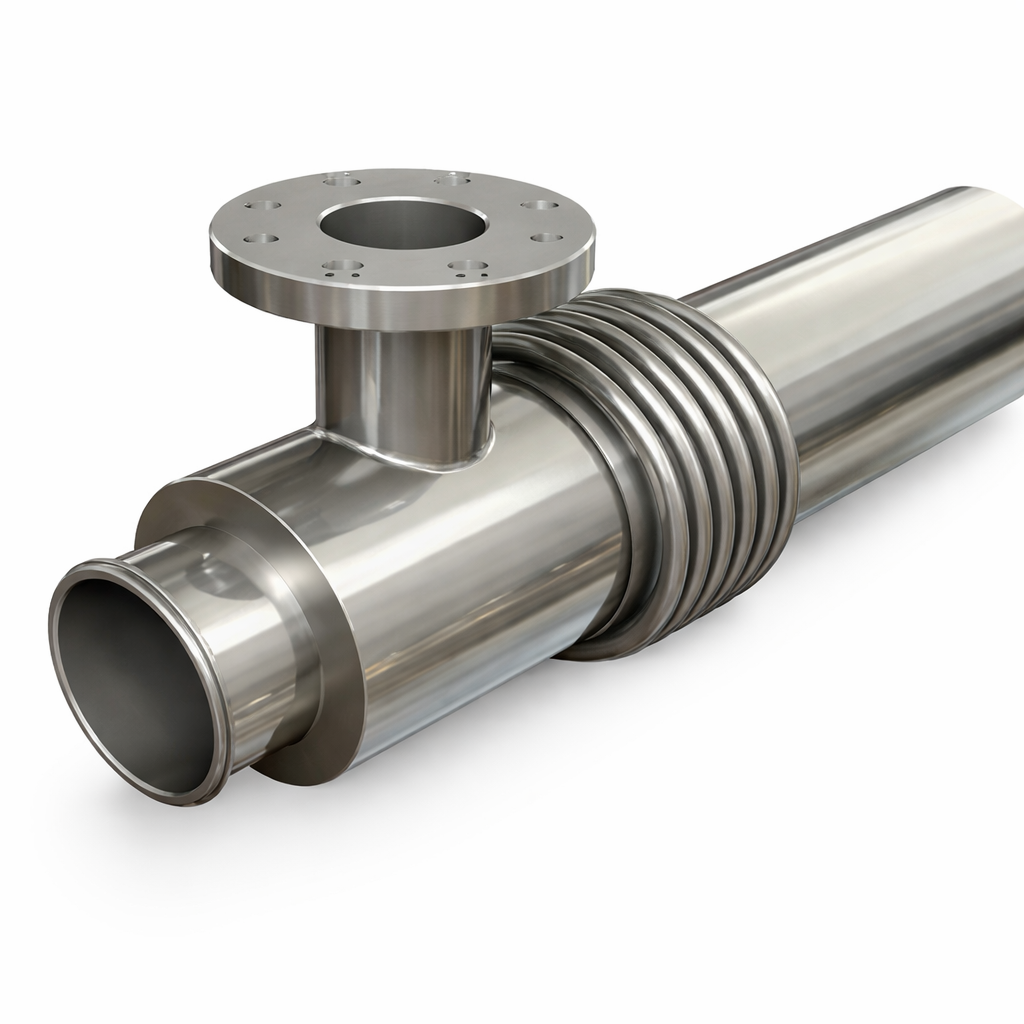
Description
“
Double Pipe Heat Exchangers are fundamental thermal transfer systems engineered to transfer heat between two fluid streams through a concentric pipe arrangement, where one fluid flows through the inner pipe while the second flows through the annular space between the two pipes. These devices are widely used in industrial processes, chemical plants, and pilot-scale operations to deliver reliable heat exchange with a compact and easily serviceable design. Their straightforward geometry allows for predictable thermal performance, making them a preferred choice in applications where simplicity, durability, and precise control are essential.
Constructed from high-quality metallic tubing — typically carbon steel, stainless steel, or copper alloys — double pipe heat exchangers support both parallel-flow and counter-flow arrangements. The counter-flow configuration maximizes the temperature differential between fluids along the entire heat transfer length, achieving superior thermal efficiency for their size. Their modular, hairpin-style assembly makes them easy to extend, clean, and maintain, while their robust construction ensures long service life even in demanding process environments.
Main Features of Double Pipe Heat Exchangers
- Simple and robust design: minimal components reduce the risk of mechanical failure.
- Counter-flow capability: maximizes thermal efficiency across the full exchanger length.
- Easy to clean and maintain: straightforward disassembly for inspection and service.
- Scalable configuration: units can be connected in series or parallel to meet capacity needs.
- Wide material compatibility: available in multiple alloys for corrosive or high-temperature fluids.
- Precise thermal control: ideal for applications requiring exact temperature management.
Technical Specifications of Double Pipe Heat Exchangers
- Type: concentric tube (pipe-within-a-pipe) heat exchanger.
- Material: carbon steel, stainless steel, copper alloys, or other process-compatible metals.
- Flow arrangement: counter-flow or parallel-flow.
- Heat transfer area: determined by pipe diameter, wall thickness, and active length.
- Operating pressure: suitable for moderate to high-pressure process conditions.
- Application range: chemical processing, oil and gas, food industry, laboratory and pilot systems.
Uses and Applications of Double Pipe Heat Exchangers
- Chemical and petrochemical processing: reactor feed preheating, product cooling, and solvent recovery.
- Oil and gas industry: crude oil heating, gas cooling, and fluid temperature conditioning.
- Food and beverage: sterilization, pasteurization, and thermal processing of viscous fluids.
- Pharmaceutical manufacturing: precise temperature control in batch and continuous processes.
- Pilot plants and R&D: scalable units for process development and thermal testing.
- Power generation: auxiliary fluid cooling and heat recovery in utility systems.
Recommendations for Installation and Use
- Select the counter-flow arrangement whenever possible to achieve maximum thermal efficiency.
- Choose pipe materials based on fluid compatibility, operating temperature, and pressure requirements.
- Inspect fittings, couplings, and gaskets regularly to prevent leaks and pressure loss.
- Clean inner and annular passages periodically to prevent fouling and maintain heat transfer performance.
- Connect multiple units in series to increase heat transfer area when process demands grow.
Frequently Asked Questions about Double Pipe Heat Exchangers
What are Double Pipe Heat Exchangers used for?
They are used to transfer heat between two process fluids in industrial, chemical, and food processing applications. Their simple design makes them especially suitable for high-pressure, high-temperature, or viscous fluid services where other exchanger types may be impractical.
How do Double Pipe Heat Exchangers work?
One fluid flows through the inner pipe while the second flows through the annular space surrounding it. In counter-flow mode, the fluids travel in opposite directions, maximizing the temperature gradient and overall heat transfer efficiency along the entire length of the unit.
What are the advantages over other heat exchanger types?
Double Pipe Heat Exchangers offer exceptional simplicity, ease of maintenance, and suitability for high-pressure and fouling-prone fluids. Their modular design allows capacity to be increased incrementally by adding sections, without replacing the entire unit.
Do they need special maintenance?
Maintenance is straightforward and involves periodic cleaning of the inner pipe and annular space, as well as inspection of mechanical joints and seals. Their open, accessible construction makes service faster and less costly compared to more complex exchanger configurations.
“