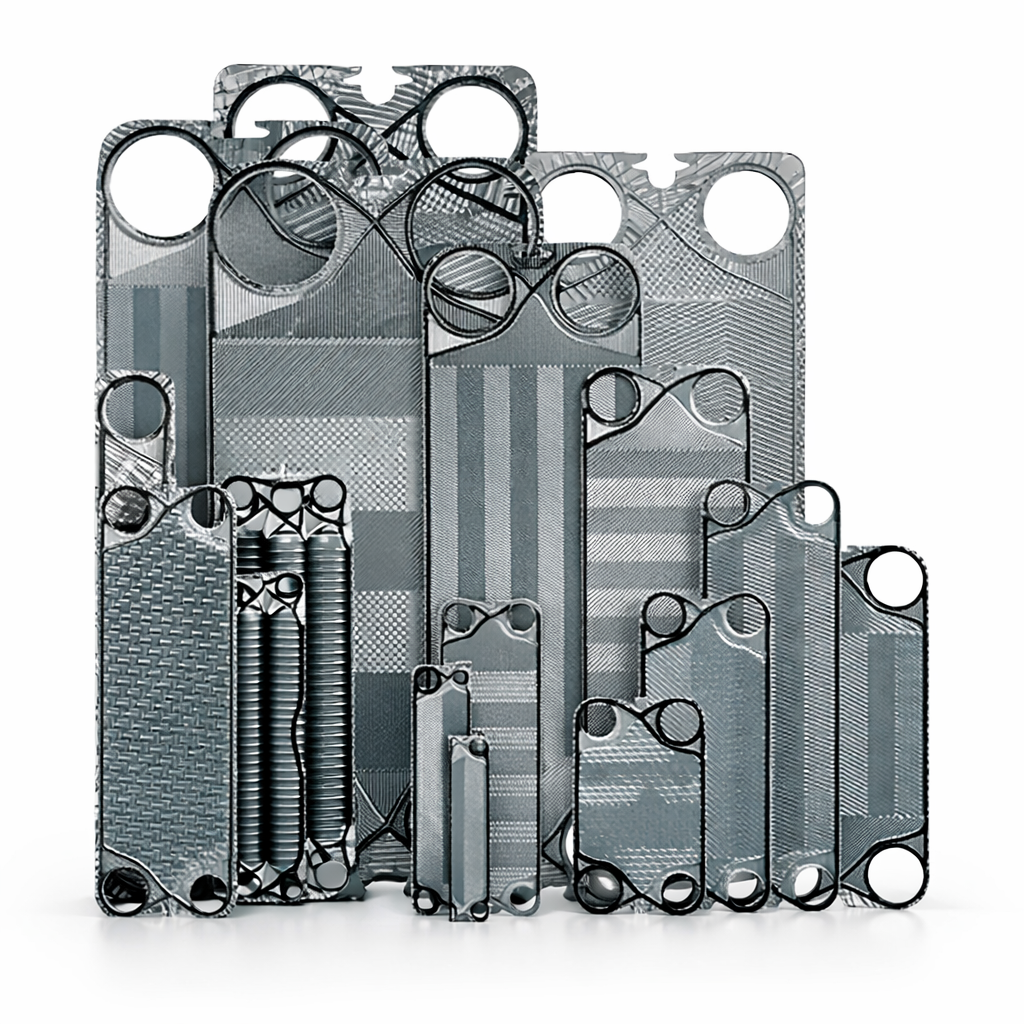
Description
Plate Heat Exchangers are advanced thermal transfer systems engineered to transfer heat between two fluid streams through a series of thin, corrugated metal plates. These devices are widely used in industrial processes, commercial systems, and HVAC applications to maximize thermal efficiency while maintaining a compact footprint. Their design allows for greater surface area contact between fluids, resulting in faster heat exchange with lower energy consumption and reduced operational costs.
Constructed from high-quality metallic plates — typically stainless steel — arranged in a gasketed or welded stack, plate heat exchangers facilitate efficient heat transfer with minimal fluid volume. The alternating flow paths created by the plates enhance turbulence, improving heat transfer rates without requiring large equipment or excessive fluid pressure. Their modular nature also enables easy capacity upgrades, maintenance, and cleaning compared to traditional shell and tube heat exchangers.
Main Features of Plate Heat Exchangers
- High thermal efficiency: optimized plate design maximizes heat exchange surface area.
- Compact and space-saving: smaller footprint compared to conventional heat exchangers.
- Modular and flexible: expansion and maintenance by adding or removing plates.
- Wide temperature range: suitable for high-temperature and low-temperature applications.
- Durable construction: corrosion-resistant materials for long service life.
- Low fluid volume: reduces energy use and improves response time.
Technical Specifications of Plate Heat Exchangers
- Type: compact plate-and-frame heat exchanger unit.
- Material: typically stainless steel plates with gaskets or welded joints.
- Flow arrangement: counter-flow or cross-flow.
- Heat transfer area: customizable based on number and size of plates.
- Operating pressure: depends on design, common in industrial ranges.
- Application range: HVAC, refrigeration, process heating, cooling circuits.
Uses and Applications of Plate Heat Exchangers
- Industrial heating and cooling: energy recovery, process temperature control.
- HVAC systems: space heating, district heating/cooling and air-handling units.
- Refrigeration: brine systems, condensers, evaporators.
- Food and beverage: pasteurization, heat recovery in processing lines.
- Chemical and petrochemical: reactor cooling, thermal separation systems.
- Power generation: auxiliary heat transfer, condenser backup.
Recommendations for Installation and Use
- Ensure proper alignment and sealing of plates during assembly to prevent leaks.
- Select plate materials based on fluid properties (e.g., corrosiveness, temperature range).
- Perform regular inspection of gaskets and seals to extend service life.
- Clean plates periodically according to system demands to prevent fouling.
- Verify compatibility with fluid pressures and temperatures before commissioning.
Frequently Asked Questions about Plate Heat Exchangers
What are Plate Heat Exchangers used for?
They are used to transfer heat between two fluids efficiently in heating, cooling, and energy recovery applications across industrial, commercial, and HVAC sectors. Their compact design makes them ideal where space and performance are priorities.
How do Plate Heat Exchangers work?
Heat is transferred through thin metal plates that separate two fluid streams. The counter-flow or cross-flow arrangement increases thermal contact, boosting efficiency without requiring bulky equipment.
What are the advantages over shell-and-tube exchangers?
Plate Heat Exchangers offer higher heat transfer efficiency, a smaller footprint, easier maintenance, and modular upgrade options. They also typically require less fluid volume and consume less energy.
Do they need special maintenance?
Maintenance mainly involves periodic cleaning and inspection of plates and gaskets. Because they operate without external lubrication and have large surface areas, they often require less frequent service than traditional designs.