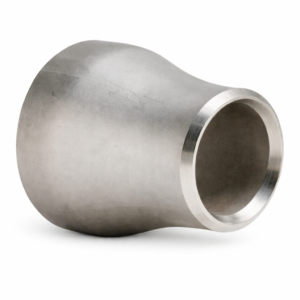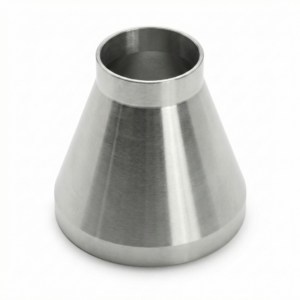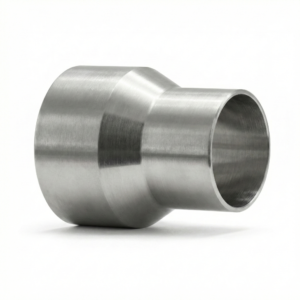

Reducers Eccentric are specialized piping fittings with one flat side, designed to join different pipe diameters while allowing for total drainage in horizontal lines or preventing air pockets in pump suctions.
The Reducer Eccentric is a high-performance fitting used when the transition between pipe sizes must happen without compromising the drainage or air-evacuation properties of the line. Unlike conical reducers, the centers of the two ends are offset, resulting in one side of the fitting being perfectly flat. This “flat-on-one-side” geometry is critical for horizontal piping runs in both industrial and sanitary sectors.
Technically, the Reducer Eccentric serves two vital purposes based on its orientation. When installed “Flat-on-Bottom” (FOB), it allows liquid to flow completely out of the pipe via gravity, preventing “puddling”—a requirement for pharmaceutical and food-grade CIP systems. When installed “Flat-on-Top” (FOT), it prevents the accumulation of air bubbles at the high point of a reduction, which is essential for pump suction lines to prevent cavitation and damage.
Our Reducers Eccentric are manufactured with the highest precision to ensure the offset angle is exact. They are made from corrosion-resistant 316L stainless steel, ensuring they can handle aggressive cleaning agents and high-temperature sterilization without losing their structural integrity or surface finish.
Key Features of Reducers Eccentric
Technical Specifications for Reducers Eccentric
Uses and Applications of Reducers Eccentric
Usage and Maintenance Recommendations for Reducers Eccentric
Frequently Asked Questions about Reducers Eccentric
Why use an eccentric reducer on a pump inlet?
Using an eccentric reducer with the flat side on top (FOT) prevents air from being trapped at the top of the reducer, which could otherwise enter the pump and cause cavitation or loss of prime.
Are eccentric reducers harder to install than concentric ones?
They require more attention to orientation. Because they are not symmetrical, the pipe fitter must ensure the flat side is oriented correctly (up or down) according to the engineering design.
Does the offset affect flow turbulence?
It can create slightly more turbulence than a perfectly centered conical reducer, but the trade-off for drainage or air prevention is usually far more important in process engineering.

Ask us on WhatsApp
Get a quote now