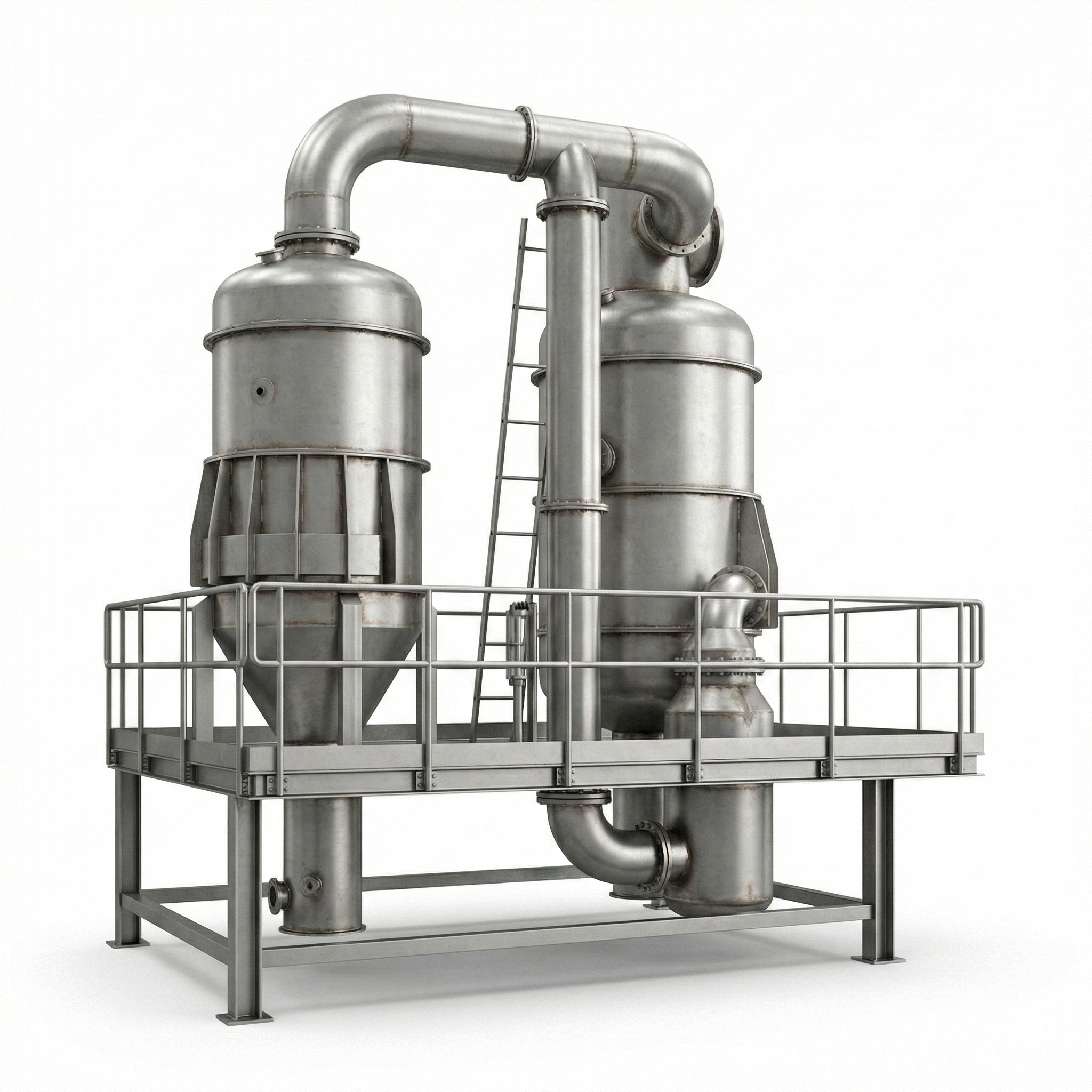
Description
The Industrial Condenser performs the inverse function of the evaporator within a thermal cycle. Its primary objective is to reject the heat absorbed by a fluid into a cooling medium (typically air or water), causing the gas to liquefy. This process is fundamental for closing the work cycle in power plants, refineries, and industrial air conditioning systems.
Various types of Industrial Condensers exist depending on the cooling medium used: air-cooled (radiator type), water-cooled (shell and tube), and evaporative condensers, which combine both principles. The selection of the appropriate model depends directly on water resource availability and the environmental conditions of the installation site.
A high-performance Industrial Condenser allows for a reduction in the discharge pressure of compressors or turbines. This translates directly into significant energy savings and a lower carbon footprint for the industrial operation.
Key Features of Industrial Condensers
- Efficient Heat Rejection: High capacity for transferring both latent and sensible heat.
- Robust Construction: Built to withstand high discharge pressures.
- Adaptable Configurations: Modular options for easy capacity expansion.
- Advanced Protection: Special coatings against atmospheric or galvanic corrosion.
- Smart Integration: Compatible with Variable Frequency Drives (VFD) for fan control.
Technical Specifications for Industrial Condensers
- Product Type: Surface or evaporative condenser.
- Cooling Medium: Ambient air, tower water, or sea/well water.
- Tube Materials: Copper, carbon steel, stainless steel, or cupronickel.
- Operating Pressure: High-pressure rating (specific to refrigerant or steam).
- Certifications: Compliance with pressure vessel standards (TEMA, ASME).
Uses and Applications of Industrial Condensers
- Power Generation: Steam condensation at the exhaust of turbines in thermal plants.
- Petrochemical Industry: Vapor recovery in distillation and fractionation processes.
- Industrial Cold Systems: Ammonia or Freon condensation in food processing plants.
- Pharmaceutical Industry: Solvent condensation in chemical reactors.
- Large-scale HVAC: Water-cooled or air-cooled chillers for industrial complexes.
Usage and Storage Recommendations for Industrial Condensers
- Keep fins or tubes free from dust, scale, and obstructions.
- For water-cooled units, strictly control water quality to prevent limescale buildup.
- Periodically inspect fans and motors to prevent excessive vibration.
- Verify liquid subcooling at the outlet to ensure maximum cycle efficiency.
Frequently Asked Questions about Industrial Condensers
Is an air-cooled or water-cooled condenser better?
Water-cooled units are thermally more efficient but require cooling towers and water treatment. Air-cooled units are easier to maintain and do not consume water, though their efficiency depends more on ambient temperature.
How does fouling affect a condenser?
Fouling creates an insulating barrier that reduces heat transfer, increasing the operating pressure and the electrical consumption of the entire system.
What is an evaporative condenser?
It is a hybrid equipment that uses the evaporation of a small amount of water sprayed over coils to cool the internal fluid, achieving lower condensing temperatures than a dry air-cooled condenser.